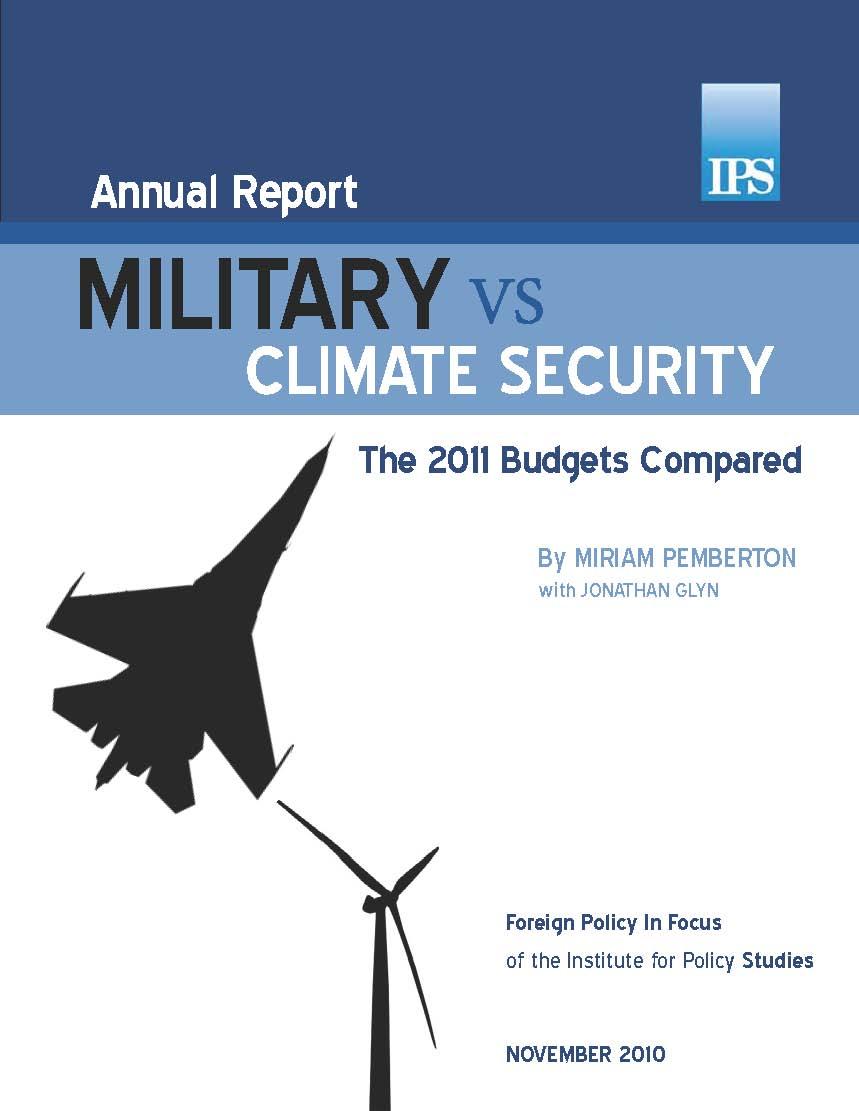
 The U.S. military now recognizes climate change as a security “threat multiplier.” Since 2008 the Institute for Policy Studies has been measuring the extent to which federal spending is being reallocated to reflect that perception. Between FY 2008 and FY 2011 the federal climate change budget more than doubled, from $7.4 billion to $18.1 billion. As a result, the gap between federal spending on military as opposed to climate security was cut more than in half. In 2008 the U.S. budgeted $94 on tools of traditional military force for every dollar spent on climate. That ratio will narrow to $41 to $1 in the 2011 fiscal year.
This is progress, obviously. But a shift of one percent of the military budget does not come close to bringing climate security investment in line with the magnitude of the threat. China’s performance in this regard is far superior. Though its military spending is not wholly transparent, the range of estimates makes it clear that China spends between $2 and $3 on its military for each $1 it spends on climate. China spends one-sixth as much as the United States does on military security, and twice as much on climate security.