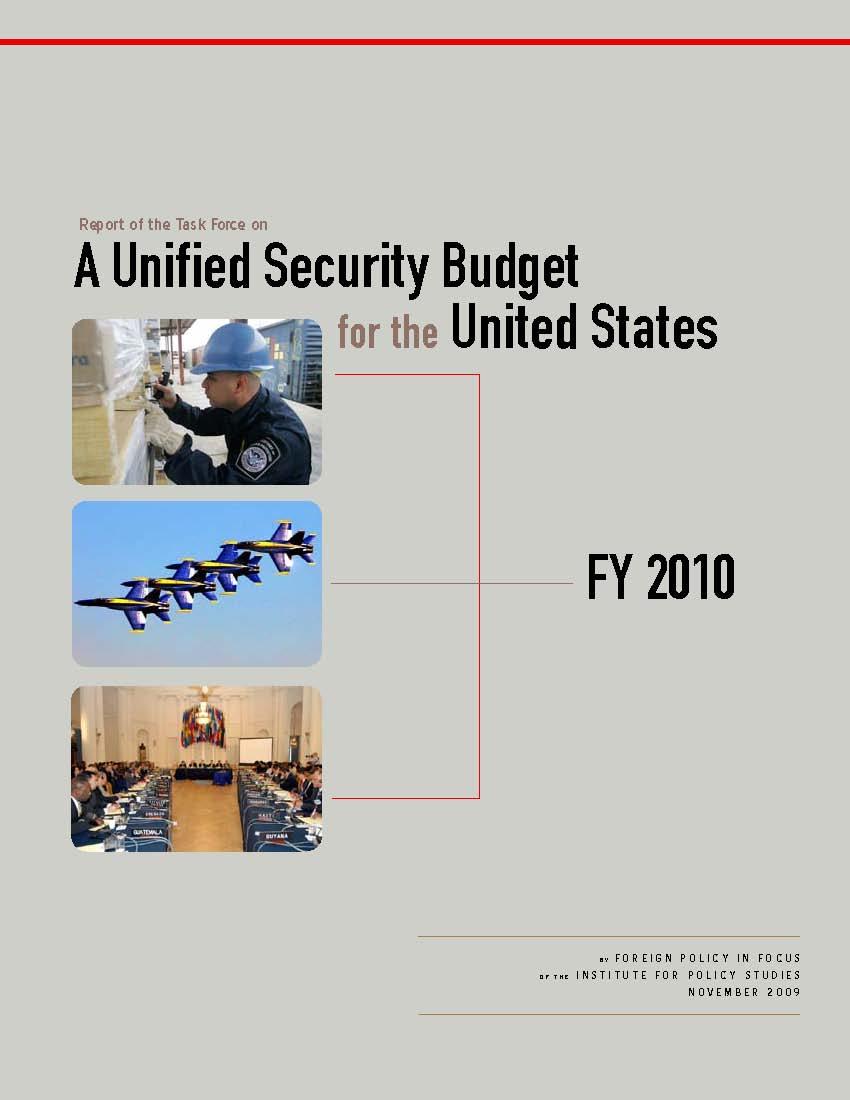
 The Obama administration promised “a sweeping shift of priorities and resources in the national security arena.” The sixth yearly Report of the Task Force on a Unified Security Budget for the United States, FY 2010 finds that the promise of resource shifting has not yet been kept. The needle tracking the overall balance of spending on offense (military forces), defense (homeland security) and prevention (non-military foreign engagement) stayed stubbornly in place. In the FY 2010 request, like the one before it, 87% of the nation’s security resources were allocated to the tools of military force. This is true even excluding the appropriations for wars the country is currently fighting.
The Task Force on a Unified Security Budget — a project of Foreign Policy In Focus at the Institute for Policy Studies — supports a shift in emphasis toward a different, less militarized approach to U.S. security policy. Expertise among the 18 members of the Task Force, drawn from academia, think tanks and nonpartisan organizations, includes military budgeting and strategy, homeland security, nonproliferation and development.
Among the report’s recommendations are that the United States:
- reduce its nuclear arsenal to 600 warheads and 400 in reserve, and eliminate the Trident II nuclear missile;
- reduce Pentagon waste through competitively awarded contracts, a well-trained and fully-staffed acquisition workforce, and expanding and updating websites providing public access to federal contracting data;
- reduce the scope of the Quadrennial Homeland Security Review (QHSR) to focus on a few big-picture issues including rationalizing the responsibilities of federal, state, local and private actors, improving risk management, harmonizing security priorities with other national interests such as privacy and commerce, and detailing how homeland security programs are to be financed and sustained over time; and
- create a Quadrennial National Security Review that would examine the budgets for offense, defense and prevention together, so that the relative balance of resource allocations can be considered as an integrated whole.